The Hidden Cost of Outdated IT Infrastructure
Many organisations continue to rely on ageing servers, networking equipment, storage systems, and software because they still “work.”



Many organisations continue to rely on ageing servers, networking equipment, storage systems, and software because they still “work.”

Organisations across industries are moving applications, data, and workloads to the cloud to improve efficiency, strengthen security, and support long-term growth.

A slow business network slows down productivity, disrupts collaboration, affects customer service, and makes everyday tasks harder than they should be.

Every business connected to the internet, regardless of size, is a potential target for cybercriminals.

Regularly assessing your technology environment can reveal opportunities to improve efficiency, strengthen security, and support future growth. Here are five important questions every business should be asking.
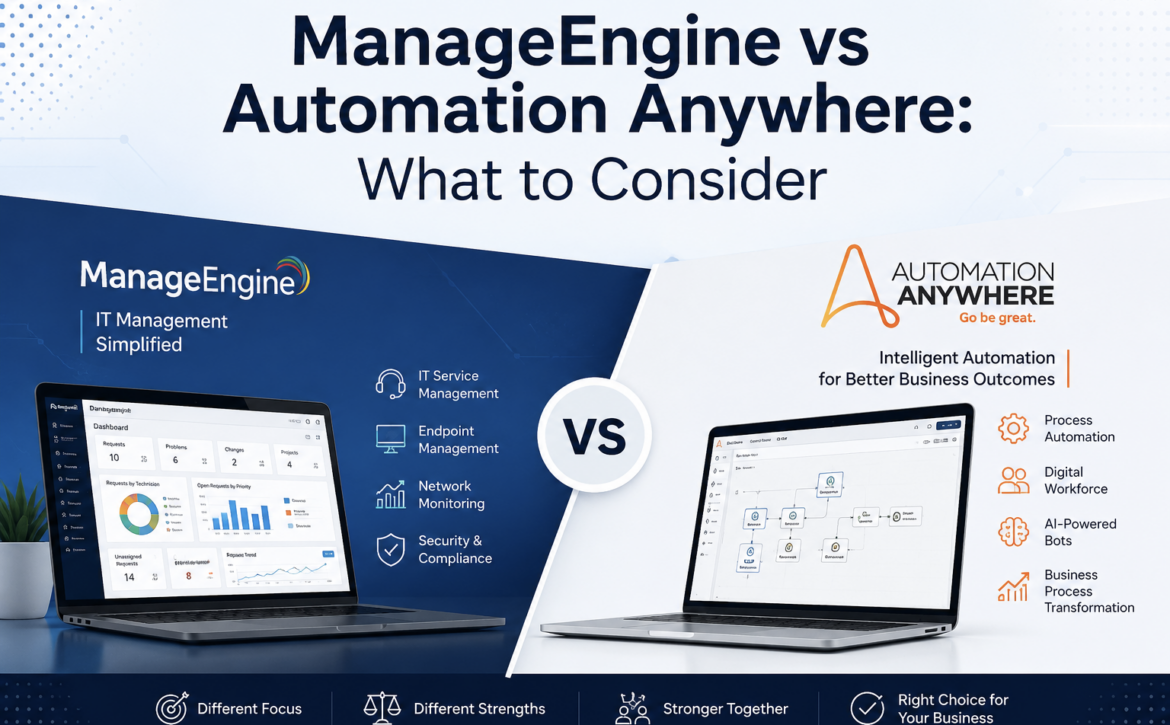
Two names that frequently appear in automation conversations are ManageEngine and Automation Anywhere. While both contribute to operational efficiency, they are designed to solve very different challenges.

Technology infrastructure has become one of the most important drivers of modern business performance. From communication and collaboration to cybersecurity, cloud computing, customer service, and data management, organisations now depend heavily on reliable IT systems to operate efficiently and remain competitive.
As digital transformation accelerates, businesses are investing more in enterprise-grade IT equipment designed to support scalability, performance, security, and long-term operational growth.
However, choosing enterprise infrastructure is no longer simply about purchasing hardware. Modern organisations need technology ecosystems capable of supporting continuous operations, increasing workloads, and evolving business demands.
The quality of your IT infrastructure directly affects productivity, business continuity, customer experience, and operational efficiency.
Enterprise IT equipment refers to the hardware and infrastructure systems businesses use to support daily operations, communication, data processing, storage, security, and connectivity.
Unlike consumer-grade technology, enterprise infrastructure is designed for:
For growing organisations, investing in the right infrastructure is essential for maintaining stability and supporting future expansion.
Servers remain the foundation of modern business operations.
They host applications, databases, email systems, virtual environments, and business-critical workloads that organisations rely on daily. As businesses handle increasing amounts of data and digital operations, server performance becomes directly tied to operational efficiency.
Modern enterprise servers are built to support scalability, virtualization, redundancy, and high-performance computing environments. Businesses that rely on outdated or underpowered servers often experience slow operations, instability, and increased downtime.
Choosing the right server infrastructure helps businesses maintain reliability while supporting future growth.
Reliable connectivity is essential for every modern organisation.
Businesses depend on stable networks for communication, cloud access, collaboration tools, and operational systems. Enterprise networking equipment such as switches, routers, wireless access points, and structured cabling systems help maintain strong and efficient connectivity across the organisation.
Poor networking infrastructure can affect productivity across entire departments, especially in environments relying heavily on cloud-based operations or hybrid work systems.
Strong network infrastructure creates faster communication, improved performance, and more stable business operations.
As businesses generate larger volumes of information, storage infrastructure becomes increasingly important.
Modern organisations require storage systems capable of handling large amounts of operational, financial, and customer data while maintaining accessibility, security, and backup capabilities.
Enterprise storage solutions help businesses improve data management, support business continuity, and reduce the risk of information loss. As cloud adoption continues growing, many organisations are also integrating hybrid storage systems that combine on-premise infrastructure with cloud environments.
Cybersecurity is now a critical part of enterprise IT infrastructure.
Businesses face increasing threats from ransomware, phishing attacks, unauthorized access, and data breaches. Without proper security systems, organisations remain vulnerable to operational disruptions and financial losses.
Enterprise cybersecurity infrastructure often includes firewalls, endpoint protection systems, access control systems, backup appliances, and monitoring tools designed to protect sensitive business information and secure operational environments.
As cyber threats continue evolving, businesses must treat cybersecurity infrastructure as a long-term operational investment rather than a temporary solution.
Many modern organisations are adopting hyperconverged infrastructure to simplify IT operations and improve scalability.
Hyperconverged infrastructure combines compute, storage, networking, and virtualization into a unified platform, reducing infrastructure complexity while improving operational efficiency.
Businesses increasingly prefer HCI because it supports easier management, stronger disaster recovery capabilities, improved scalability, and better system performance.
For organisations looking to modernize their infrastructure environments, HCI has become one of the most effective enterprise technology solutions available today.
Reliable power infrastructure remains essential for business continuity, especially in environments where power instability can disrupt operations.
Unexpected outages can damage equipment, interrupt workflows, and lead to costly downtime or data loss. This is why enterprise environments often rely on UPS systems, backup power infrastructure, and power protection systems designed to maintain operational stability.
Protecting IT infrastructure from power-related disruptions is just as important as securing the systems themselves.
The right enterprise IT infrastructure improves far more than technical performance.
It strengthens productivity, supports scalability, improves customer experience, enhances cybersecurity, and helps businesses operate more efficiently overall.
Poor infrastructure, on the other hand, often creates recurring downtime, security vulnerabilities, maintenance issues, and operational inefficiencies that slow business growth.
Modern organisations are increasingly recognizing that IT infrastructure is no longer simply a support function operating quietly in the background. It has become a strategic business asset.
At NetFocus Technologies, we help organisations design, deploy, and manage enterprise IT infrastructure tailored to their operational needs. We also we work with globally recognized OEM partners including Dell EMC, Microsoft, AWS, Lenovo, HP, Red Hat, IBM, and other leading technology providers to deliver enterprise infrastructure solutions that meet international standards for performance, security, scalability, and reliability.
Our solutions include:
We help businesses build reliable technology environments designed for performance, scalability, security, and long-term operational growth.
Contact NetFocus Technologies today at info@netfocusng.com

Every email sent, cloud application accessed, video conference hosted, or customer transaction processed depends on a reliable network infrastructure operating behind the scenes. Yet while businesses often invest heavily in software, cybersecurity, and enterprise systems, one critical component is frequently overlooked: structured cabling.
Without a solid cabling infrastructure, even the most advanced technology systems can suffer from poor performance, downtime, unreliable connectivity, and expensive maintenance issues.
This is why structured cabling remains one of the most important foundations of modern IT infrastructure.
Structured cabling is a standardized system of cables, connectors, and network hardware designed to support an organisation’s communication infrastructure.
Rather than relying on disorganized wiring added over time, structured cabling creates a centralized and organized framework that connects a company’s data, voice, internet, wireless, and security systems into one scalable network.
Think of it as the physical backbone of your IT environment. A properly structured cabling system allows all your technology systems to communicate efficiently while making the network easier to manage, troubleshoot, and expand as your business grows.
Many businesses only realize the importance of structured cabling after network problems begin affecting operations. Poorly arranged cabling systems can lead to:
As businesses become increasingly dependent on digital tools, cloud platforms, and real-time communication systems, network reliability becomes non-negotiable.
Structured cabling helps eliminate these issues by creating a cleaner, more organized, and more efficient infrastructure environment.
One of the biggest benefits of structured cabling is improved network performance. When cabling systems are properly designed and installed, businesses experience faster data transmission, stronger connectivity, and fewer interruptions across their operations. This becomes especially important for organisations handling large amounts of data, running cloud-based systems, or supporting multiple departments simultaneously.
A reliable network infrastructure also improves employee productivity. Teams can collaborate more efficiently without constant connectivity issues slowing down workflows or disrupting communication.
Messy network environments are notoriously difficult to manage. In many offices, years of unmanaged installations result in tangled cables, undocumented connections, and infrastructure confusion that makes troubleshooting incredibly time-consuming.
Structured cabling solves this problem by creating an organized system where cables are properly labeled, documented, and arranged logically.
This allows IT teams to identify faults faster, carry out maintenance more efficiently, and reduce downtime whenever technical issues occur.
Business technology evolves constantly. As organisations grow, they add more employees, devices, cloud services, communication systems, and operational tools. Without scalable infrastructure, expansion often becomes expensive and disruptive.
Structured cabling is designed with future growth in mind. Instead of rebuilding an entire network every time the business expands, new devices and systems can be integrated into the existing infrastructure more efficiently.
This flexibility helps businesses scale operations without unnecessary infrastructure complications.
Today’s organisations depend heavily on technologies such as:
All these systems require stable, high-performance network infrastructure to function properly. Structured cabling creates the foundation needed to support these technologies consistently and reliably.
Without it, businesses often struggle with instability, bottlenecks, and poor system performance.
Downtime is expensive. When network systems fail, business operations can slow down or stop entirely. Communication becomes difficult, employees lose productivity, and customer experience may suffer.
Structured cabling minimizes these risks by improving network stability and reducing infrastructure-related failures.
A properly designed system also makes it easier to isolate and resolve issues before they escalate into major operational disruptions.
Structured cabling is not simply about installing wires throughout a building. It requires proper infrastructure planning, network design expertise, performance optimization, and scalability considerations. Poor installations often create long-term operational problems that become expensive to fix later.
Businesses need infrastructure that supports both current operational needs and future growth. That is why working with experienced IT infrastructure professionals is critical.
At NetFocus Technologies, we design and implement structured cabling systems that support reliable, scalable, and high-performance business operations.
We help organisations build network infrastructures that improve connectivity, simplify maintenance, reduce downtime, and support long-term growth.
Our solutions include:
Whether you are setting up a new office, upgrading an existing infrastructure, or preparing your business for digital transformation, we help you build systems you can rely on.
Ready to strengthen your network infrastructure? Contact NetFocus Technologies today at info@netfocusng.com

As technology becomes central to business operations, many organisations face a critical decision: should IT be managed internally, outsourced entirely, or supported by external consultants?
Two common approaches organisations consider are Managed IT Services and IT Consulting. While both involve external technology expertise, they serve very different purposes.
Understanding the difference helps businesses choose the right model for their needs, whether they are looking to solve a specific technology challenge or maintain a fully supported IT environment.
Managed IT Services involve outsourcing the ongoing management, monitoring, and maintenance of an organisation’s IT infrastructure to a specialized provider.
Instead of relying solely on internal IT teams, businesses partner with a managed service provider (MSP) that continuously oversees their technology systems.
Managed IT services typically include:
The goal is to ensure that IT systems run reliably, securely, and efficiently without constant internal intervention.
Managed services are ideal for organisations that:
Rather than reacting to issues after they occur, managed services focus on proactive maintenance and prevention.
IT consulting, on the other hand, is typically project-based and advisory-focused.
An IT consulting firm provides expert guidance to help organisations make strategic technology decisions, design systems, or implement new infrastructure.
Common IT consulting services include:
Unlike managed services, consultants usually do not handle daily IT operations. Instead, they provide the expertise needed to solve specific challenges or guide major technology initiatives.
IT consulting is valuable when an organisation needs:
For example, a company planning to deploy a new data center or migrate to cloud infrastructure may engage consultants to design the architecture before implementation.
| Managed IT Services | IT Consulting |
| Ongoing operational support | Project-based advisory services |
| Focuses on managing and maintaining IT systems | Focuses on strategy, planning, and design |
| Long-term partnership | Temporary engagement |
| Continuous monitoring and support | Expertise for specific initiatives |
| Prevents operational disruptions | Guides major technology decisions |
In many cases, businesses benefit from both models working together.
Consultants may design the architecture for a system, while managed service providers handle its long-term maintenance and monitoring.
The right approach depends on your organisation’s size, internal capabilities, and technology goals.
Some businesses maintain internal IT teams but rely on external consultants for strategic initiatives. Others outsource most of their infrastructure management through managed services to ensure continuous support.
A hybrid approach is increasingly common, where organisations combine strategic consulting with ongoing IT management to achieve both innovation and operational stability.
Whether implementing new systems or maintaining existing infrastructure, having the right technology partner can significantly improve efficiency, security, and scalability.
Experienced IT solution providers help organisations:
This allows businesses to focus on their core operations while ensuring their technology ecosystem remains secure and efficient.
At NetFocus, we provide both strategic IT consulting and comprehensive managed IT services to help organisations build and maintain robust technology environments.
Our solutions include:
Whether your organisation needs expert guidance for a major technology project or reliable long-term IT management, NetFocus delivers the expertise and support required to keep your business running smoothly.
Contact NetFocus today to discuss how our IT solutions can support your organisation’s growth and technology strategy.