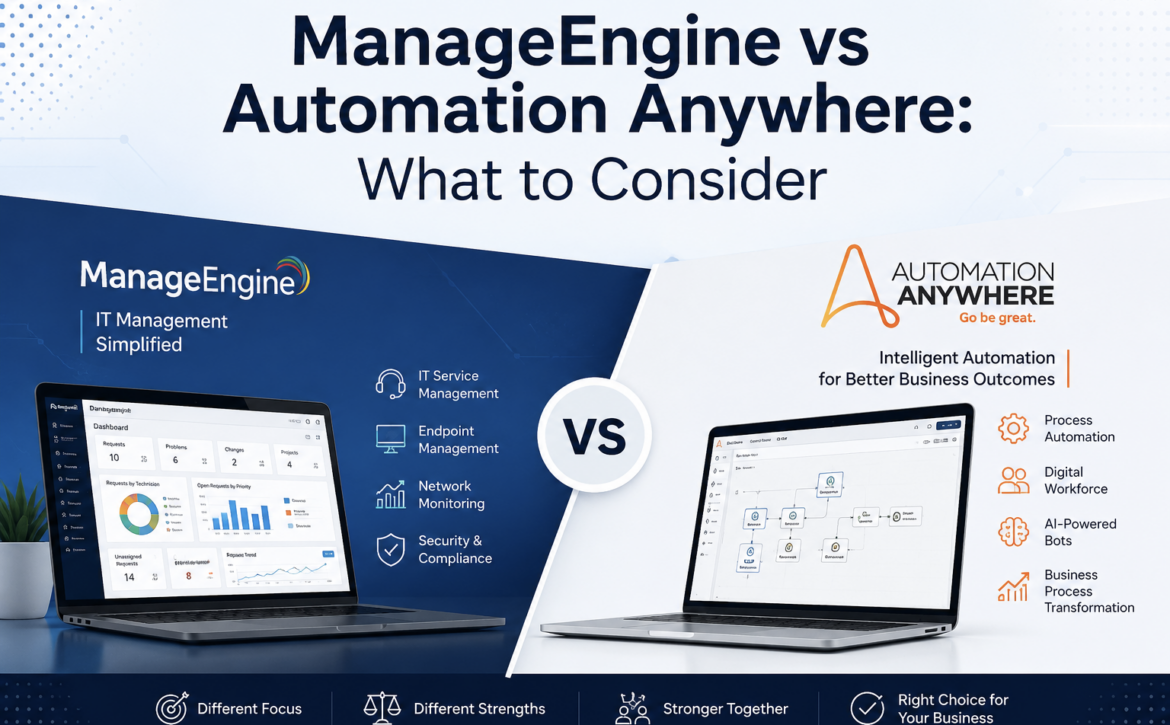
ManageEngine vs Automation Anywhere: What Businesses Should Consider

Two names that frequently appear in automation conversations are ManageEngine and Automation Anywhere. While both contribute to operational efficiency, they are designed to solve very different challenges.

Read More

Why Standardized Devices Make IT Management Easier

As organisations grow, managing technology becomes increasingly complex. Different laptop models, operating systems, hardware specifications, and software configurations can create unnecessary challenges for IT teams and employees alike.

While device diversity may seem harmless, it often introduces inefficiencies that impact productivity, security, and support operations. This is why many successful organisations adopt a standardized device strategy.

What Does Device Standardization Mean?

Device standardization involves deploying approved hardware and software configurations across the organisation.

Rather than allowing a mix of different devices and specifications, businesses establish consistent technology standards for employees. This creates a more predictable and manageable IT environment.

The Challenges of a Mixed Device Environment

When employees use devices with varying specifications and configurations, several issues can emerge.

  1. Inconsistent Performance

Different hardware capabilities can result in inconsistent user experiences across teams. Some employees may experience slower performance, while others work on more capable systems. This inconsistency can affect productivity and collaboration.

  1. Compatibility Issues

A diverse device ecosystem often increases software compatibility challenges. Applications may behave differently across systems, requiring additional troubleshooting and support.

  1. Increased Support Demands

IT teams spend more time diagnosing device-specific issues when every system is different. This increases support costs and slows response times.

Benefits of Standardized Devices

A standardized technology environment offers significant operational advantages.

  1. Faster Deployment

New employees can be onboarded more quickly when devices are preconfigured according to established standards.

  1. Easier Maintenance

Consistent hardware and software environments simplify troubleshooting, updates, and routine maintenance.

  1. Improved Security

Security policies can be applied more consistently across devices. This reduces vulnerabilities and strengthens endpoint protection.

  1. Simplified Asset Management

Tracking devices, warranties, upgrades, and replacements becomes significantly easier when technology standards are in place.

  1. Supporting Business Growth

Scalability requires consistency. As organisations expand, managing hundreds of unique devices becomes increasingly difficult. Standardization creates a foundation that supports growth without increasing complexity.

Businesses can deploy technology more efficiently, maintain stronger security controls, and improve user experiences across teams.

By standardizing devices and hardware environments, organisations can reduce complexity, improve efficiency, and create a more scalable IT infrastructure.

NetFocus supplies enterprise-grade laptops, desktops, workstations, networking equipment, and other business-critical hardware designed to support modern operations. Whether you’re equipping a growing team or refreshing your existing infrastructure, we help organisations build reliable, standardized technology environments that are easier to manage and ready to scale.

Reach out to us at info@netfocusng.com to make your enquiries.


Read More

Best Enterprise IT Equipment for Modern Organisations

Technology infrastructure has become one of the most important drivers of modern business performance. From communication and collaboration to cybersecurity, cloud computing, customer service, and data management, organisations now depend heavily on reliable IT systems to operate efficiently and remain competitive.

As digital transformation accelerates, businesses are investing more in enterprise-grade IT equipment designed to support scalability, performance, security, and long-term operational growth.

However, choosing enterprise infrastructure is no longer simply about purchasing hardware. Modern organisations need technology ecosystems capable of supporting continuous operations, increasing workloads, and evolving business demands.

The quality of your IT infrastructure directly affects productivity, business continuity, customer experience, and operational efficiency.

What Is Enterprise IT Equipment?

Enterprise IT equipment refers to the hardware and infrastructure systems businesses use to support daily operations, communication, data processing, storage, security, and connectivity.

Unlike consumer-grade technology, enterprise infrastructure is designed for:

  • Higher performance
  • Increased reliability
  • Large-scale operations
  • Continuous uptime
  • Advanced security
  • Scalability

For growing organisations, investing in the right infrastructure is essential for maintaining stability and supporting future expansion.

1. Enterprise Servers

Servers remain the foundation of modern business operations.

They host applications, databases, email systems, virtual environments, and business-critical workloads that organisations rely on daily. As businesses handle increasing amounts of data and digital operations, server performance becomes directly tied to operational efficiency.

Modern enterprise servers are built to support scalability, virtualization, redundancy, and high-performance computing environments. Businesses that rely on outdated or underpowered servers often experience slow operations, instability, and increased downtime.

Choosing the right server infrastructure helps businesses maintain reliability while supporting future growth.

2. Networking Equipment

Reliable connectivity is essential for every modern organisation.

Businesses depend on stable networks for communication, cloud access, collaboration tools, and operational systems. Enterprise networking equipment such as switches, routers, wireless access points, and structured cabling systems help maintain strong and efficient connectivity across the organisation.

Poor networking infrastructure can affect productivity across entire departments, especially in environments relying heavily on cloud-based operations or hybrid work systems.

Strong network infrastructure creates faster communication, improved performance, and more stable business operations.

3. Enterprise Storage Solutions

As businesses generate larger volumes of information, storage infrastructure becomes increasingly important.

Modern organisations require storage systems capable of handling large amounts of operational, financial, and customer data while maintaining accessibility, security, and backup capabilities.

Enterprise storage solutions help businesses improve data management, support business continuity, and reduce the risk of information loss. As cloud adoption continues growing, many organisations are also integrating hybrid storage systems that combine on-premise infrastructure with cloud environments.

4. Cybersecurity Infrastructure

Cybersecurity is now a critical part of enterprise IT infrastructure.

Businesses face increasing threats from ransomware, phishing attacks, unauthorized access, and data breaches. Without proper security systems, organisations remain vulnerable to operational disruptions and financial losses.

Enterprise cybersecurity infrastructure often includes firewalls, endpoint protection systems, access control systems, backup appliances, and monitoring tools designed to protect sensitive business information and secure operational environments.

As cyber threats continue evolving, businesses must treat cybersecurity infrastructure as a long-term operational investment rather than a temporary solution.

5. Hyperconverged Infrastructure (HCI)

Many modern organisations are adopting hyperconverged infrastructure to simplify IT operations and improve scalability.

Hyperconverged infrastructure combines compute, storage, networking, and virtualization into a unified platform, reducing infrastructure complexity while improving operational efficiency.

Businesses increasingly prefer HCI because it supports easier management, stronger disaster recovery capabilities, improved scalability, and better system performance.

For organisations looking to modernize their infrastructure environments, HCI has become one of the most effective enterprise technology solutions available today.

6. Power Backup and Protection Systems

Reliable power infrastructure remains essential for business continuity, especially in environments where power instability can disrupt operations.

Unexpected outages can damage equipment, interrupt workflows, and lead to costly downtime or data loss. This is why enterprise environments often rely on UPS systems, backup power infrastructure, and power protection systems designed to maintain operational stability.

Protecting IT infrastructure from power-related disruptions is just as important as securing the systems themselves.

Why Enterprise IT Infrastructure Matters

The right enterprise IT infrastructure improves far more than technical performance.

It strengthens productivity, supports scalability, improves customer experience, enhances cybersecurity, and helps businesses operate more efficiently overall.

Poor infrastructure, on the other hand, often creates recurring downtime, security vulnerabilities, maintenance issues, and operational inefficiencies that slow business growth.

Modern organisations are increasingly recognizing that IT infrastructure is no longer simply a support function operating quietly in the background. It has become a strategic business asset.

How NetFocus Technologies Supports Modern Businesses

At NetFocus Technologies, we help organisations design, deploy, and manage enterprise IT infrastructure tailored to their operational needs. We also we work with globally recognized OEM partners including Dell EMC, Microsoft, AWS, Lenovo, HP, Red Hat, IBM, and other leading technology providers to deliver enterprise infrastructure solutions that meet international standards for performance, security, scalability, and reliability.

Our solutions include:

  • Enterprise hardware supply
  • Server deployment
  • Hyperconverged infrastructure
  • Structured cabling systems
  • Network infrastructure solutions
  • Data center support
  • Disaster recovery systems
  • IT infrastructure consulting

We help businesses build reliable technology environments designed for performance, scalability, security, and long-term operational growth.

Contact NetFocus Technologies today at info@netfocusng.com

Read More

Structured Cabling Explained: The Backbone of Modern IT Infrastructure

Every email sent, cloud application accessed, video conference hosted, or customer transaction processed depends on a reliable network infrastructure operating behind the scenes. Yet while businesses often invest heavily in software, cybersecurity, and enterprise systems, one critical component is frequently overlooked: structured cabling.

Without a solid cabling infrastructure, even the most advanced technology systems can suffer from poor performance, downtime, unreliable connectivity, and expensive maintenance issues.

This is why structured cabling remains one of the most important foundations of modern IT infrastructure.

What Is Structured Cabling?

Structured cabling is a standardized system of cables, connectors, and network hardware designed to support an organisation’s communication infrastructure.

Rather than relying on disorganized wiring added over time, structured cabling creates a centralized and organized framework that connects a company’s data, voice, internet, wireless, and security systems into one scalable network.

Think of it as the physical backbone of your IT environment. A properly structured cabling system allows all your technology systems to communicate efficiently while making the network easier to manage, troubleshoot, and expand as your business grows.

Why Structured Cabling Matters for Businesses

Many businesses only realize the importance of structured cabling after network problems begin affecting operations. Poorly arranged cabling systems can lead to:

  • Slow network performance
  • Frequent downtime
  • Difficult troubleshooting
  • Higher maintenance costs
  • Limited scalability
  • Reduced operational efficiency

As businesses become increasingly dependent on digital tools, cloud platforms, and real-time communication systems, network reliability becomes non-negotiable.

Structured cabling helps eliminate these issues by creating a cleaner, more organized, and more efficient infrastructure environment.

Improved Network Performance and Reliability

One of the biggest benefits of structured cabling is improved network performance. When cabling systems are properly designed and installed, businesses experience faster data transmission, stronger connectivity, and fewer interruptions across their operations. This becomes especially important for organisations handling large amounts of data, running cloud-based systems, or supporting multiple departments simultaneously.

A reliable network infrastructure also improves employee productivity. Teams can collaborate more efficiently without constant connectivity issues slowing down workflows or disrupting communication.

Easier Maintenance and Troubleshooting

Messy network environments are notoriously difficult to manage. In many offices, years of unmanaged installations result in tangled cables, undocumented connections, and infrastructure confusion that makes troubleshooting incredibly time-consuming.

Structured cabling solves this problem by creating an organized system where cables are properly labeled, documented, and arranged logically.

This allows IT teams to identify faults faster, carry out maintenance more efficiently, and reduce downtime whenever technical issues occur.

Scalability for Growing Organisations

Business technology evolves constantly. As organisations grow, they add more employees, devices, cloud services, communication systems, and operational tools. Without scalable infrastructure, expansion often becomes expensive and disruptive.

Structured cabling is designed with future growth in mind. Instead of rebuilding an entire network every time the business expands, new devices and systems can be integrated into the existing infrastructure more efficiently.

This flexibility helps businesses scale operations without unnecessary infrastructure complications.

Better Support for Modern Technologies

Today’s organisations depend heavily on technologies such as:

  • Cloud computing
  • Video conferencing
  • IP surveillance systems
  • Smart office technology
  • Enterprise applications
  • Hybrid work environments

All these systems require stable, high-performance network infrastructure to function properly. Structured cabling creates the foundation needed to support these technologies consistently and reliably.

Without it, businesses often struggle with instability, bottlenecks, and poor system performance.

Reduced Downtime and Operational Disruption

Downtime is expensive. When network systems fail, business operations can slow down or stop entirely. Communication becomes difficult, employees lose productivity, and customer experience may suffer.

Structured cabling minimizes these risks by improving network stability and reducing infrastructure-related failures.

A properly designed system also makes it easier to isolate and resolve issues before they escalate into major operational disruptions.

Why Professional Installation Matters

Structured cabling is not simply about installing wires throughout a building. It requires proper infrastructure planning, network design expertise, performance optimization, and scalability considerations. Poor installations often create long-term operational problems that become expensive to fix later.

Businesses need infrastructure that supports both current operational needs and future growth. That is why working with experienced IT infrastructure professionals is critical.

How NetFocus Technologies Helps Businesses Build Reliable Infrastructure

At NetFocus Technologies, we design and implement structured cabling systems that support reliable, scalable, and high-performance business operations.

We help organisations build network infrastructures that improve connectivity, simplify maintenance, reduce downtime, and support long-term growth.

Our solutions include:

  • Structured cabling deployment
  • Network infrastructure design
  • Enterprise connectivity solutions
  • Data center support
  • IT infrastructure optimization
  • Scalable network architecture

Whether you are setting up a new office, upgrading an existing infrastructure, or preparing your business for digital transformation, we help you build systems you can rely on.

Ready to strengthen your network infrastructure? Contact NetFocus Technologies today at info@netfocusng.com

Read More

Common Data Security Mistakes Businesses Make

From phishing attacks and ransomware to insider threats and data breaches, organisations today face constant risks that can disrupt operations and damage customer trust.

In many cases, businesses do not suffer breaches because hackers are exceptionally advanced. They suffer breaches because of weak internal systems, outdated infrastructure, poor cybersecurity awareness, or careless data handling practices.

Why Data Security Matters More Than Ever

Modern organisations manage large volumes of sensitive information every day. Customer records, financial data, login credentials, internal reports, contracts, and employee information all require proper protection.

When this information is compromised, the consequences can be severe. Businesses may experience financial losses, reputational damage, operational downtime, regulatory penalties, and loss of customer confidence.

The stronger your cybersecurity systems are, the lower your exposure to risk.

1. Weak Password Practices

One of the most common cybersecurity mistakes businesses make is poor password management. Employees often use simple passwords, repeat passwords across multiple systems, or share credentials internally without proper controls. Once a password is compromised, attackers can gain unauthorized access to sensitive systems and critical business information.

Strong password policies are essential for modern organisations. Businesses should also implement multi-factor authentication and proper access management systems to reduce security risks significantly.

2. Failing to Train Employees on Cybersecurity Awareness

Technology alone cannot fully protect a business from cyber threats. Human error remains one of the leading causes of security breaches worldwide. Employees who cannot identify phishing emails, suspicious links, fake login pages, or malicious attachments can unknowingly expose an entire organisation to attack.

Cybersecurity awareness training helps staff recognize threats before they become incidents. Businesses that invest in continuous employee education are often far better protected against preventable attacks.

3. Ignoring Software Updates and System Patches

Outdated software creates major security vulnerabilities. Cybercriminals actively exploit old operating systems, unsupported applications, and unpatched software because these systems often contain known weaknesses.

Businesses that delay updates expose themselves unnecessarily to attacks that could have been prevented easily. Regular system updates, patch management, and infrastructure maintenance are critical parts of a strong cybersecurity strategy.

4. Poor Access Control Management

Not every employee should have unrestricted access to sensitive information. Many organisations fail to properly manage user permissions, administrative privileges, and internal access restrictions. This increases the risk of accidental exposure, insider misuse, or unauthorized activity within the system.

Businesses should implement structured access controls that limit data access based on roles and responsibilities. Sensitive information should only be accessible to authorized personnel.

5. Not Backing Up Critical Data Properly

Many businesses underestimate the importance of backup systems until data is already lost. Without proper backups, organisations become vulnerable to ransomware attacks, server failures, accidental deletion, and operational disruptions. In some cases, businesses may lose critical information permanently.

A strong backup strategy should include automated backups, secure storage environments, disaster recovery planning, and regular testing to ensure systems can be restored quickly when needed.

6. Storing Sensitive Information Insecurely

Sensitive business information should never be stored carelessly on unsecured devices or poorly protected systems.

Yet many organisations still store confidential files in unprotected cloud folders, shared drives without restrictions, or personal devices lacking proper security controls.

Businesses handling customer data, financial records, or internal operational information must prioritize secure storage systems, encryption, and controlled access environments.

7. Operating Without a Disaster Recovery Plan

Cybersecurity is not only about preventing attacks. It is also about recovering quickly when incidents occur.

When systems go down, response time becomes critical. Without a structured disaster recovery plan, businesses may struggle to restore operations, recover lost data, or maintain continuity during disruptions.

A strong disaster recovery strategy helps organisations minimize downtime, protect critical systems, and continue operating even during unexpected incidents.

Cybersecurity Requires a Proactive Approach

Many businesses approach cybersecurity reactively, only responding after problems occur. Unfortunately, by the time a breach happens, the financial and operational damage may already be significant.

Effective cybersecurity requires continuous monitoring, regular assessments, infrastructure upgrades, employee training, and proactive risk management. Businesses that prioritize prevention are often far more resilient in the long run.

How NetFocus Technologies Helps Businesses Stay Secure

At NetFocus Technologies, we help organisations build secure, resilient, and reliable IT environments designed to protect critical business operations.

Our cybersecurity solutions include:

  • Data protection systems
  • Security assessments and audits
  • Disaster recovery solutions
  • Backup and recovery infrastructure
  • Access control implementation
  • Infrastructure security support

We work proactively with businesses to identify vulnerabilities, strengthen security systems, and reduce operational risk before problems escalate.

As cyber threats continue to evolve, businesses cannot afford to treat cybersecurity as an afterthought. Are you ready to strengthen your business security infrastructure?

Contact NetFocus Technologies today: info@netfocusng.com

Read More

Why Businesses in Nigeria Are Moving to Paperless Operations

Across Nigeria, businesses are under increasing pressure to operate faster, reduce costs, improve collaboration, and manage information more efficiently. Yet many organisations still rely heavily on paper-based systems for approvals, documentation, record keeping, invoicing, HR processes, and internal communication.

The problem is that paper slows everything down. This is why more businesses in Nigeria are moving toward paperless operations. From banks and healthcare providers to government institutions, schools, logistics companies, and corporate organisations, digitization is becoming a business necessity.

What Does It Mean to Go Paperless?

Going paperless means replacing physical documents and manual record systems with digital processes and electronic document management systems.

Instead of storing files in cabinets, documents are securely stored digitally where they can be searched, accessed, updated, and shared instantly.

This often includes:

  • Document digitization
  • Digital file management
  • Cloud storage systems
  • Electronic approvals and workflows
  • Automated record management
  • Digital archiving
  • Workflow automation software

A paperless office is not simply about scanning documents. It is about creating a more efficient and connected way of working.

Why Nigerian Businesses Are Embracing Paperless Operations

1. Rising Operational Costs

Paper-based operations come with hidden expenses that accumulate over time:

  • Printing costs
  • Paper purchases
  • Storage infrastructure
  • Physical archiving
  • Courier and logistics expenses
  • Manual administrative labour

For large organisations handling thousands of records monthly, these costs become significant. Digitization helps businesses reduce administrative overhead while improving operational efficiency.

2. Faster Access to Information

One of the biggest frustrations in paper-heavy organisations is document retrieval. Teams waste valuable time searching for physical files, requesting approvals manually, or waiting for documents to move between departments.

With digital document management systems:

  • Files become searchable instantly
  • Access permissions can be controlled
  • Teams can collaborate remotely
  • Documents can be retrieved in seconds

This dramatically improves workflow speed and decision-making.

3. Remote and Hybrid Work Demands

The workplace has changed permanently.

Modern businesses require systems that allow employees to work securely from multiple locations without depending on physical files or office-based access.

Paperless systems support:

  • Remote collaboration
  • Cloud-based access
  • Digital approvals
  • Centralized document storage
  • Business continuity during disruptions

This flexibility is now critical for business resilience.

4. Improved Security and Compliance

Contrary to popular belief, physical documents are often more vulnerable than digital systems.

Paper records can be:

  • Lost
  • Damaged by fire or flooding
  • Accessed without authorization
  • Difficult to audit
  • Hard to track

Modern digital systems provide:

  • Access controls
  • Audit trails
  • Backup systems
  • Encryption
  • Disaster recovery support

This is particularly important for industries handling sensitive customer or financial information.

5. Better Customer Experience

Customers expect speed. Businesses that still rely on slow manual processes often struggle with:

  • Delayed service delivery
  • Slow approvals
  • Long response times
  • Inefficient customer support

Digitized operations help organisations respond faster, process requests more efficiently, and improve customer satisfaction.

Common Challenges Businesses Face During Digitization

Despite the benefits, many organisations hesitate to transition because they fear:

  • Data migration challenges
  • Disruption to operations
  • Security concerns
  • Staff resistance
  • Infrastructure limitations

However, successful digitization is not about replacing everything overnight. The best approach is a structured transition plan that aligns technology with business operations.

The Future of Business Operations Is Digital

Businesses that continue relying entirely on paper systems may eventually struggle to compete in an increasingly digital economy.

Digitization is no longer only for large corporations. Small and medium-sized businesses are also adopting digital systems to improve efficiency, reduce costs, and scale operations more effectively.

The organisations gaining competitive advantages today are the ones building smarter operational systems now.

How NetFocus Technologies Can Help

At NetFocus Technologies, we help organisations transition from paper-heavy environments into structured digital ecosystems designed for efficiency, security, and scalability.

Our digitization solutions include:

  • Document digitization
  • Electronic document management systems
  • Workflow automation
  • Cloud integration
  • Secure digital archiving
  • Enterprise infrastructure support

We work with businesses across industries to simplify operations, improve access to information, and build systems that support long-term growth.

Ready to move toward a smarter, paperless operation? Contact NetFocus Technologies today:
info@netfocusng.com

Read More

How to Build a Data-Driven Organisation

In our digital economy, data has become one of the most valuable assets an organisation possesses. Every transaction, customer interaction, operational process, and digital touchpoint generates information that can be used to guide smarter decisions.

Yet many organisations collect large volumes of data without fully using it to drive strategy. Becoming a truly data-driven organisation requires more than storing information, it requires the right infrastructure, processes, and culture to transform raw data into actionable insight.

Here are the key steps organisations must take to build a data-driven enterprise.

1. Establish a Clear Data Strategy

The journey toward becoming data-driven begins with a clearly defined strategy.

Organisations must first determine:

  • What data is most valuable to the business
  • What decisions data should support
  • How data will be collected, stored, and analysed
  • Who is responsible for managing and governing data assets

Without a defined strategy, data initiatives often become fragmented, leading to isolated systems and underutilised information.

A clear data strategy ensures that all technology investments and analytics efforts support broader business objectives.

2. Build the Right Data Infrastructure

A strong data foundation is essential for organisations that want to extract meaningful insights from their information.

This includes the deployment of infrastructure capable of handling large data volumes while maintaining reliability and security.

Key components often include:

  • Scalable storage systems
  • Data warehouses or data lakes
  • Secure networking infrastructure
  • High-performance computing environments
  • Data integration platforms

With the right infrastructure in place, organisations can collect and process data from multiple sources without compromising performance or accessibility.

3. Break Down Data Silos

In many organisations, data is stored across different departments and systems that do not communicate effectively with each other.

Sales teams may have their own databases, operations may use separate systems, and finance departments often maintain independent reporting tools. These silos make it difficult to generate a unified view of the business.

A data-driven organisation integrates these systems so that information flows seamlessly across the enterprise.

This integration allows leadership teams to access accurate, real-time insights that reflect the entire organisation rather than isolated departments.

4. Invest in Data Analytics and Reporting Tools

Collecting data alone does not create value — analysis does.

Modern analytics platforms allow organisations to transform raw data into insights that support operational improvements, customer understanding, and strategic planning.

Effective analytics solutions can help organisations:

  • Identify operational inefficiencies
  • Predict customer behavior
  • Improve resource allocation
  • Monitor performance in real time

With intuitive dashboards and reporting tools, decision-makers can access the insights they need without relying solely on technical teams.

5. Strengthen Data Governance and Security

As organisations rely more heavily on data, the importance of governance and protection increases.

Data-driven organisations must implement policies that ensure information remains:

  • Accurate
  • Consistent
  • Secure
  • Compliant with regulatory standards

This includes establishing clear data ownership, access controls, security monitoring, and compliance frameworks.

Strong governance not only protects sensitive information but also ensures that decision-makers can trust the data they rely on.

6. Build a Data-Driven Culture

Leaders must encourage teams to use data in everyday decision-making processes. This requires cultivating a culture where employees understand the value of data and feel empowered to use insights to guide their work.

Organisations can foster this culture by:

  • Promoting data literacy across teams
  • Providing access to analytics tools
  • Encouraging evidence-based decision making
  • Integrating data insights into strategic discussions

When data becomes part of the organisation’s mindset, decision-making becomes more objective, strategic, and efficient.

The Role of Technology Partners in Data Transformation

Building a data-driven organisation requires expertise across multiple domains, including infrastructure design, system integration, cybersecurity, and analytics architecture.

Many organisations partner with experienced IT solution providers to ensure their data infrastructure is built for scalability, security, and long-term innovation.

Technology partners can help organisations deploy the platforms and systems required to transform data into a powerful competitive advantage.

Empower Your Organisation with NetFocus

NetFocus helps organisations build the technology foundations required to unlock the full value of their data.

Our enterprise solutions support businesses in:

  • Deploying scalable data infrastructure
  • Integrating enterprise systems
  • Securing critical data assets
  • Optimising IT environments for analytics and innovation

Whether your organisation is beginning its data transformation journey or expanding existing capabilities, NetFocus provides the expertise needed to build a secure, scalable, and insight-driven enterprise.

Contact NetFocus today to learn how we can help your organisation become truly data-driven.

Read More

Managed IT Services vs IT Consulting: Understanding the Difference

As technology becomes central to business operations, many organisations face a critical decision: should IT be managed internally, outsourced entirely, or supported by external consultants?

Two common approaches organisations consider are Managed IT Services and IT Consulting. While both involve external technology expertise, they serve very different purposes.

Understanding the difference helps businesses choose the right model for their needs, whether they are looking to solve a specific technology challenge or maintain a fully supported IT environment.

What Are Managed IT Services?

Managed IT Services involve outsourcing the ongoing management, monitoring, and maintenance of an organisation’s IT infrastructure to a specialized provider.

Instead of relying solely on internal IT teams, businesses partner with a managed service provider (MSP) that continuously oversees their technology systems.

Managed IT services typically include:

  • 24/7 system monitoring
  • Network and infrastructure management
  • Endpoint management
  • Cybersecurity monitoring
  • Data backup and disaster recovery
  • Software updates and patch management
  • Helpdesk support for employees

The goal is to ensure that IT systems run reliably, securely, and efficiently without constant internal intervention.

When Managed IT Services Make Sense

Managed services are ideal for organisations that:

  • Want predictable IT management costs
  • Lack large internal IT teams
  • Need continuous monitoring and security
  • Want to reduce downtime and operational risks

Rather than reacting to issues after they occur, managed services focus on proactive maintenance and prevention.

What Is IT Consulting?

IT consulting, on the other hand, is typically project-based and advisory-focused.

An IT consulting firm provides expert guidance to help organisations make strategic technology decisions, design systems, or implement new infrastructure.

Common IT consulting services include:

  • IT strategy development
  • Digital transformation planning
  • Infrastructure architecture design
  • Cybersecurity assessments
  • Technology audits
  • System integration planning

Unlike managed services, consultants usually do not handle daily IT operations. Instead, they provide the expertise needed to solve specific challenges or guide major technology initiatives.

When IT Consulting Is the Right Choice

IT consulting is valuable when an organisation needs:

  • Strategic technology guidance
  • Expertise for complex projects
  • Infrastructure design or architecture planning
  • Digital transformation support

For example, a company planning to deploy a new data center or migrate to cloud infrastructure may engage consultants to design the architecture before implementation.

Key Differences Between Managed IT Services and IT Consulting

Managed IT ServicesIT Consulting
Ongoing operational supportProject-based advisory services
Focuses on managing and maintaining IT systemsFocuses on strategy, planning, and design
Long-term partnershipTemporary engagement
Continuous monitoring and supportExpertise for specific initiatives
Prevents operational disruptionsGuides major technology decisions

In many cases, businesses benefit from both models working together.

Consultants may design the architecture for a system, while managed service providers handle its long-term maintenance and monitoring.

The right approach depends on your organisation’s size, internal capabilities, and technology goals.

Some businesses maintain internal IT teams but rely on external consultants for strategic initiatives. Others outsource most of their infrastructure management through managed services to ensure continuous support.

A hybrid approach is increasingly common, where organisations combine strategic consulting with ongoing IT management to achieve both innovation and operational stability.

Why the Right Technology Partner Matters

Whether implementing new systems or maintaining existing infrastructure, having the right technology partner can significantly improve efficiency, security, and scalability.

Experienced IT solution providers help organisations:

  • Design resilient infrastructure
  • Strengthen cybersecurity posture
  • Optimise technology investments
  • Maintain reliable IT environments

This allows businesses to focus on their core operations while ensuring their technology ecosystem remains secure and efficient.

Partner with NetFocus for Enterprise IT Solutions

At NetFocus, we provide both strategic IT consulting and comprehensive managed IT services to help organisations build and maintain robust technology environments.

Our solutions include:

  • IT infrastructure design and deployment
  • Network and systems management
  • Cybersecurity solutions
  • Data center and cloud infrastructure
  • Ongoing IT support and monitoring

Whether your organisation needs expert guidance for a major technology project or reliable long-term IT management, NetFocus delivers the expertise and support required to keep your business running smoothly.

Contact NetFocus today to discuss how our IT solutions can support your organisation’s growth and technology strategy.

Read More

Practical Steps Nigerian Businesses Can Take to Prevent Data Breaches

Data breaches are no longer rare incidents affecting only global corporations. Increasingly, businesses across Nigeria, from financial institutions and logistics companies to SMEs and government agencies, are becoming targets of cyberattacks.

A single breach can expose sensitive customer data, disrupt operations, damage reputation, and lead to regulatory consequences. Yet many organisations remain vulnerable because basic cybersecurity practices are not fully implemented.

Here are practical steps Nigerian businesses can take to strengthen their security posture.

1. Implement Strong Access Controls

One of the most common causes of data breaches is unauthorised access to sensitive systems. Businesses should ensure that employees only have access to the data and systems necessary for their roles. This is known as the principle of least privilege.

Effective access control measures include:

  • Role-based access permissions
  • Multi-factor authentication (MFA)
  • Regular access reviews
  • Immediate revocation of access for departing employees

Limiting system access significantly reduces the risk of internal misuse or compromised credentials.

2. Keep Systems and Software Updated

Outdated systems are one of the easiest entry points for attackers. Cybercriminals often exploit known vulnerabilities in unpatched software. Regular updates and security patches close these gaps before they can be exploited.

Nigerian businesses should establish a structured patch management process that ensures:

  • Operating systems are updated regularly
  • Security patches are applied promptly
  • Third-party applications are monitored for vulnerabilities

Routine updates may seem simple, but they are one of the most effective defenses against cyber threats.

3. Secure Endpoints and Employee Devices

With remote work and mobile access becoming common, laptops, smartphones, and other endpoints are now major security risks.

An unsecured device can serve as a gateway into the entire corporate network. Businesses should implement endpoint security policies such as:

  • Device encryption
  • Endpoint detection and response (EDR) solutions
  • Remote device management
  • Automatic security updates

Monitoring and managing all devices connected to the network helps prevent data leakage and unauthorised access.

4. Train Employees on Cybersecurity Awareness

Technology alone cannot prevent breaches if employees are unaware of common cyber threats.

Phishing emails, malicious attachments, and social engineering attacks remain some of the most successful methods used by attackers.

Regular training programs should teach employees how to:

  • Identify phishing emails
  • Avoid suspicious links and attachments
  • Use secure passwords
  • Report unusual system activity

A well-informed workforce acts as an additional layer of security for the organisation.

5. Backup Critical Data Regularly

Even with strong security measures in place, no system is completely immune to cyber incidents.

Regular backups ensure that organisations can recover quickly in the event of ransomware attacks, system failures, or data corruption.

Effective backup strategies include:

  • Automated backups
  • Off-site or cloud storage
  • Periodic backup testing
  • Secure backup access controls

Reliable backup systems significantly reduce the operational impact of cyber incidents.

6. Monitor Networks for Suspicious Activity

Many breaches go undetected for weeks or even months because organisations lack proper monitoring systems.

Continuous network monitoring helps identify unusual activity before it escalates into a major incident.

Businesses should implement tools such as:

  • Intrusion detection systems (IDS)
  • Security monitoring platforms
  • Log analysis and threat detection solutions

Early detection enables faster response and reduces potential damage.

7. Develop a Data Breach Response Plan

Despite best efforts, security incidents can still occur. What matters is how quickly and effectively an organisation responds.

Every business should have a clearly documented incident response plan that outlines:

  • Steps for identifying and containing breaches
  • Roles and responsibilities during an incident
  • Communication procedures
  • Regulatory reporting requirements

Preparation ensures that the organisation can respond swiftly and minimise disruption.

The Importance of a Proactive Cybersecurity Strategy

Cyber threats continue to evolve, and organisations must continuously adapt their defenses.

For many Nigerian businesses, managing cybersecurity internally can be complex due to limited resources, expertise, or technology infrastructure. Partnering with experienced IT solution providers can help organisations implement enterprise-grade security measures while maintaining focus on their core operations.

Strengthen Your Security with NetFocus

NetFocus provides enterprise cybersecurity and IT infrastructure solutions designed to help organisations:

  • Secure endpoints and networks
  • Monitor systems for threats
  • Implement data protection strategies
  • Build resilient IT environments

Contact NetFocus today to learn how we can help protect your business from data breaches and evolving cyber threats.

Read More

Data Center Deployment in Nigeria: What Every Enterprise Should Know

Managing company data securely, reliably, and efficiently requires a properly designed data center environment. Here is what every enterprise should understand before embarking on a data center deployment project.

Read More