Best Business Laptops in Nigeria: What to Look for Before You Buy
Whether you’re equipping a growing team or planning a company-wide device refresh, here are seven factors every organisation should consider before investing in business laptops.



Whether you’re equipping a growing team or planning a company-wide device refresh, here are seven factors every organisation should consider before investing in business laptops.

Whether you’re a growing SME or a large enterprise, avoiding these common mistakes can save your organisation significant time, money, and operational headaches.

Many organisations continue to rely on ageing servers, networking equipment, storage systems, and software because they still “work.”

Organisations across industries are moving applications, data, and workloads to the cloud to improve efficiency, strengthen security, and support long-term growth.

A slow business network slows down productivity, disrupts collaboration, affects customer service, and makes everyday tasks harder than they should be.

Every business connected to the internet, regardless of size, is a potential target for cybercriminals.

Regularly assessing your technology environment can reveal opportunities to improve efficiency, strengthen security, and support future growth. Here are five important questions every business should be asking.
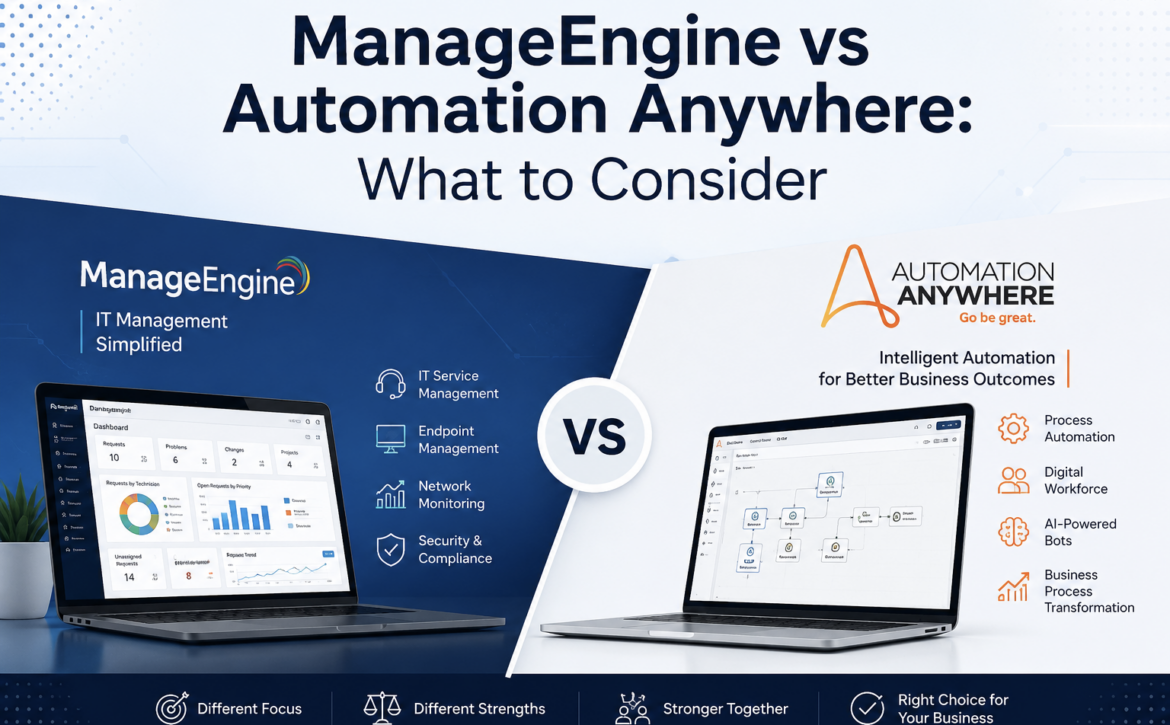
Two names that frequently appear in automation conversations are ManageEngine and Automation Anywhere. While both contribute to operational efficiency, they are designed to solve very different challenges.

Technology infrastructure has become one of the most important drivers of modern business performance. From communication and collaboration to cybersecurity, cloud computing, customer service, and data management, organisations now depend heavily on reliable IT systems to operate efficiently and remain competitive.
As digital transformation accelerates, businesses are investing more in enterprise-grade IT equipment designed to support scalability, performance, security, and long-term operational growth.
However, choosing enterprise infrastructure is no longer simply about purchasing hardware. Modern organisations need technology ecosystems capable of supporting continuous operations, increasing workloads, and evolving business demands.
The quality of your IT infrastructure directly affects productivity, business continuity, customer experience, and operational efficiency.
Enterprise IT equipment refers to the hardware and infrastructure systems businesses use to support daily operations, communication, data processing, storage, security, and connectivity.
Unlike consumer-grade technology, enterprise infrastructure is designed for:
For growing organisations, investing in the right infrastructure is essential for maintaining stability and supporting future expansion.
Servers remain the foundation of modern business operations.
They host applications, databases, email systems, virtual environments, and business-critical workloads that organisations rely on daily. As businesses handle increasing amounts of data and digital operations, server performance becomes directly tied to operational efficiency.
Modern enterprise servers are built to support scalability, virtualization, redundancy, and high-performance computing environments. Businesses that rely on outdated or underpowered servers often experience slow operations, instability, and increased downtime.
Choosing the right server infrastructure helps businesses maintain reliability while supporting future growth.
Reliable connectivity is essential for every modern organisation.
Businesses depend on stable networks for communication, cloud access, collaboration tools, and operational systems. Enterprise networking equipment such as switches, routers, wireless access points, and structured cabling systems help maintain strong and efficient connectivity across the organisation.
Poor networking infrastructure can affect productivity across entire departments, especially in environments relying heavily on cloud-based operations or hybrid work systems.
Strong network infrastructure creates faster communication, improved performance, and more stable business operations.
As businesses generate larger volumes of information, storage infrastructure becomes increasingly important.
Modern organisations require storage systems capable of handling large amounts of operational, financial, and customer data while maintaining accessibility, security, and backup capabilities.
Enterprise storage solutions help businesses improve data management, support business continuity, and reduce the risk of information loss. As cloud adoption continues growing, many organisations are also integrating hybrid storage systems that combine on-premise infrastructure with cloud environments.
Cybersecurity is now a critical part of enterprise IT infrastructure.
Businesses face increasing threats from ransomware, phishing attacks, unauthorized access, and data breaches. Without proper security systems, organisations remain vulnerable to operational disruptions and financial losses.
Enterprise cybersecurity infrastructure often includes firewalls, endpoint protection systems, access control systems, backup appliances, and monitoring tools designed to protect sensitive business information and secure operational environments.
As cyber threats continue evolving, businesses must treat cybersecurity infrastructure as a long-term operational investment rather than a temporary solution.
Many modern organisations are adopting hyperconverged infrastructure to simplify IT operations and improve scalability.
Hyperconverged infrastructure combines compute, storage, networking, and virtualization into a unified platform, reducing infrastructure complexity while improving operational efficiency.
Businesses increasingly prefer HCI because it supports easier management, stronger disaster recovery capabilities, improved scalability, and better system performance.
For organisations looking to modernize their infrastructure environments, HCI has become one of the most effective enterprise technology solutions available today.
Reliable power infrastructure remains essential for business continuity, especially in environments where power instability can disrupt operations.
Unexpected outages can damage equipment, interrupt workflows, and lead to costly downtime or data loss. This is why enterprise environments often rely on UPS systems, backup power infrastructure, and power protection systems designed to maintain operational stability.
Protecting IT infrastructure from power-related disruptions is just as important as securing the systems themselves.
The right enterprise IT infrastructure improves far more than technical performance.
It strengthens productivity, supports scalability, improves customer experience, enhances cybersecurity, and helps businesses operate more efficiently overall.
Poor infrastructure, on the other hand, often creates recurring downtime, security vulnerabilities, maintenance issues, and operational inefficiencies that slow business growth.
Modern organisations are increasingly recognizing that IT infrastructure is no longer simply a support function operating quietly in the background. It has become a strategic business asset.
At NetFocus Technologies, we help organisations design, deploy, and manage enterprise IT infrastructure tailored to their operational needs. We also we work with globally recognized OEM partners including Dell EMC, Microsoft, AWS, Lenovo, HP, Red Hat, IBM, and other leading technology providers to deliver enterprise infrastructure solutions that meet international standards for performance, security, scalability, and reliability.
Our solutions include:
We help businesses build reliable technology environments designed for performance, scalability, security, and long-term operational growth.
Contact NetFocus Technologies today at info@netfocusng.com